
By Amaury Ponce, Founder of JRP Demolition
Summary:
- Cost: Residential demolition in Dallas typically runs $6,000 to $25,000, depending on home size, materials, and site conditions.
- Permits: The City of Dallas requires a demolition permit before any structure can come down.
- Asbestos: Homes built before 1980 may need asbestos testing before work begins.
- Timeline: Most projects take one to three weeks from permit to final cleanup.
- What’s covered: This guide walks through costs, permits, timelines, the step-by-step process, and how to choose the right contractor.
Whether you’re clearing a lot for new construction, removing a home damaged by severe weather, or tearing down a property that’s simply past the point of renovation, residential demolition is one of the biggest decisions you’ll make as a homeowner.
It’s also one of the most misunderstood. Most Dallas homeowners have never been through the demolition process before. Questions pile up quickly. How much will it cost? Do you need a permit? How long will it take? What happens to all the debris?
We’ve put together this guide to answer all of those questions with Dallas-specific details you won’t find in a generic article. At JRP Demolition, we’ve handled residential demolition projects across the DFW metroplex for over 10 years, and we know exactly what homeowners in this area need to plan for. Below, we’ll walk you through costs, permits, timelines, the demolition process, and how to choose a contractor you can trust.
What Is Residential Demolition?
Residential demolition is the process of tearing down a house or other residential structure, either partially or completely, and removing all debris from the site. It differs from commercial demolition, which involves larger buildings like offices, warehouses, and retail spaces that often require specialized equipment and more complex permitting. For a broader look at all types of demolition work in the area, see our comprehensive guide to demolition services in Dallas-Fort Worth.
There are three main types of residential demolition:
Full Home Tear-Down
This is the most common type. The entire structure is demolished using heavy equipment (typically a hydraulic excavator), and all materials are loaded into roll-off containers for disposal. The lot is then graded and cleared for new construction or resale.
Partial Demolition
Sometimes you only need to remove part of a structure. This could mean taking down an attached garage, a damaged addition, a shed, or an auxiliary building while leaving the main home intact. Partial demolition requires more precision to protect the remaining structure.
Interior Demolition
Interior demolition (sometimes called a “gut job”) strips the inside of a home down to the studs without touching the exterior walls or roof. This is common for major renovations where you want to keep the shell of the home but completely rebuild the interior.
When Do Homeowners Choose Demolition Over Renovation?
Not every aging home needs to be torn down. But demolition often makes more sense than renovation in several situations:
- The renovation cost exceeds 50% of the home’s market value. At that point, you’re often better off starting fresh.
- The foundation has serious structural damage. Large cracks, shifting walls, and sagging floors usually mean the home can’t be saved cost-effectively.
- Hazardous materials are widespread. Homes with extensive asbestos, lead paint, or mold contamination can cost more to remediate than to demolish and rebuild.
- The home doesn’t meet current building codes and bringing it into compliance would require a near-total rebuild anyway.
- You want to build a completely different floor plan that the existing structure can’t accommodate.
How Much Does Residential Demolition Cost in Dallas?
Residential demolition in Dallas typically costs between $4 and $15 per square foot, with most full home tear-downs falling in the $6,000 to $25,000 range. The wide range depends on your home’s size, construction materials, accessibility, and whether hazardous materials are present.
Here’s a breakdown of what to expect based on home size:
Cost by Home Size
| Home Size (sq ft) | Estimated Cost Range |
|---|---|
| 1,000 sq ft | $5,000 to $10,000 |
| 1,500 sq ft | $7,500 to $15,000 |
| 2,000 sq ft | $10,000 to $20,000 |
| 2,500+ sq ft | $15,000 to $25,000+ |
These estimates include the demolition itself, debris removal, and basic site grading. They do not include permit fees, utility disconnections, or asbestos testing, which we’ll cover below.
What Affects the Price?
Several factors can push your project toward the higher or lower end of the range:
- Construction materials. Brick and concrete homes cost more to demolish than wood-frame homes because the materials are heavier and harder to break apart.
- Asbestos or hazardous materials. If your home was built before 1980, there’s a good chance it contains asbestos in the insulation, flooring, or siding. Asbestos abatement must be completed before demolition can begin, and it adds $2,000 to $10,000 or more depending on the extent of contamination.
- Site accessibility. Homes on tight lots, steep grades, or near other structures require more careful work and smaller equipment, which increases labor costs.
- Basement or crawl space. Homes with basements or deep crawl spaces add to the removal scope because the below-grade structure needs to be excavated and filled.
- Debris volume. Larger homes produce more debris, which means more roll-off containers and more hauling trips.
Additional Costs to Budget For
Beyond the demolition itself, plan for these common add-ons:
| Item | Estimated Cost |
|---|---|
| City of Dallas demolition permit | $42 base + $0.021/sq ft |
| Utility disconnections (electric, gas, water, sewer) | $500 to $2,500 |
| Asbestos inspection | $300 to $800 |
| Asbestos abatement (if needed) | $2,000 to $10,000+ |
| Tree removal (if required) | $500 to $2,000 per tree |
| Site grading and compaction | Often included; $500 to $1,500 if separate |
| Soil testing (for new construction) | $300 to $600 |
The best way to get an accurate number is to request a free on-site estimate from a licensed contractor who can assess your specific property.
Do You Need a Demolition Permit in Dallas?
Yes. The City of Dallas requires a demolition permit before any residential structure over 120 square feet can be torn down. This applies to full home demolitions, partial demolitions, and the removal of accessory structures like garages and sheds. Working without a permit can result in fines, stop-work orders, and complications when you try to sell or rebuild on the property.
How to Apply
Dallas handles demolition permits through its Development Services department. You can apply online through the DallasNow portal or in person at City Hall. The base fee is $42 plus $0.021 per square foot of the structure being demolished. For a 2,000-square-foot home, that works out to about $84 in permit fees.
What You’ll Need
The permit application typically requires:
- A completed application form
- Proof of property ownership or owner authorization
- A site plan showing the structure to be demolished
- Confirmation that all utilities have been disconnected
- An asbestos survey (for structures built before 1980)
- Contractor license and insurance documentation
The Historic Preservation Overlay
If your property falls within one of Dallas’s demolition delay overlay districts, you may face a mandatory 45-day waiting period before the permit can be issued. This gives the city’s Landmark Commission time to review the property’s historical significance. Not all Dallas neighborhoods have this overlay, so check with Development Services early in your planning process.
Asbestos Requirements in Texas
Texas law, administered by the Texas Department of State Health Services, requires a thorough asbestos inspection before demolishing any commercial building and most residential structures. A licensed asbestos inspector must conduct the survey, and if asbestos-containing materials are found, a certified abatement contractor must remove them before demolition begins. Demolition contractors are also required to submit a 10-day advance notification to TDSHS before starting work.
For single-family homes that are owner-occupied, there are some exemptions for residential properties, but we strongly recommend getting an inspection regardless. Asbestos exposure is a serious health hazard, and handling it properly protects your family, your neighbors, and the demolition crew.
The Residential Demolition Process: What to Expect Step by Step
Understanding the process helps you plan better and sets realistic expectations. Here’s what a typical residential demolition project looks like in the Dallas area.
Site Assessment & Estimate
On-site visit, property evaluation, and written estimate
Permits & Utility Disconnection
Secure City of Dallas permit, disconnect all utilities
Hazardous Material Testing
Asbestos inspection and abatement (pre-1980 homes)
Demolition Day
Systematic tear-down with heavy equipment (1-3 days)
Debris Removal & Site Cleanup
Hauling, recycling, grading, and final inspection
Step 1: Site Assessment and Estimate
Everything starts with an on-site visit. A qualified demolition contractor will walk your property, assess the structure, note any potential complications (hazardous materials, neighboring structures, underground utilities), and provide a written estimate. At JRP Demolition, we provide free on-site estimates with no obligation. We believe that transparency starts before the first piece of equipment arrives.
Step 2: Permits and Utility Disconnection
Once you’ve accepted an estimate, the next step is securing the demolition permit and disconnecting all utilities. This includes electricity, natural gas, water, sewer, cable, and phone lines. Each utility provider in Dallas has its own disconnection process and timeline, and this step can take anywhere from one to three weeks depending on provider scheduling.
Your contractor should handle the permit application on your behalf. At JRP Demolition, we manage the entire permitting process so you don’t have to navigate city offices yourself.
Step 3: Hazardous Material Testing and Abatement
If your home was built before 1980, a licensed inspector will test for asbestos, lead paint, and other hazardous materials. If any are found, a certified abatement team will remove them before demolition begins. This step is both a legal requirement and a safety priority. We believe there is no substitute for safety, and we never cut corners on hazardous material handling.
Step 4: Demolition Day
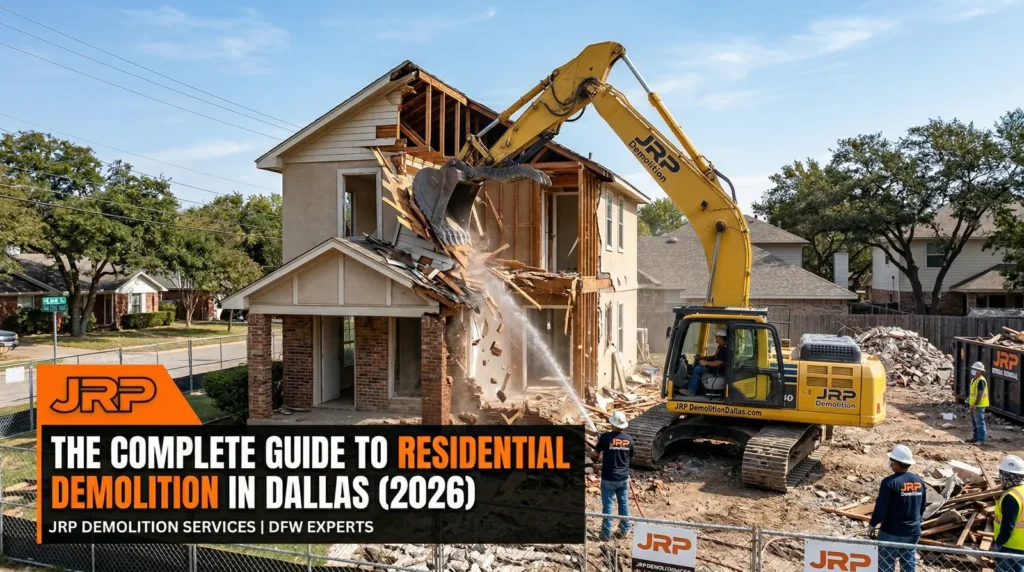
This is the part most people picture when they think about demolition. The crew arrives early, walks the site, and begins work with a clear plan. For most residential projects, the primary tool is a hydraulic excavator that systematically tears down the structure section by section. The operator works methodically, starting with the roof and working down to the foundation.
Expect noise, dust, and heavy equipment on-site throughout the day. A good contractor will have dust suppression measures in place (typically water spraying) and will coordinate with neighbors in advance. The actual tear-down of a standard single-family home typically takes one to three days.
Step 5: Debris Removal, Site Grading, and Cleanup
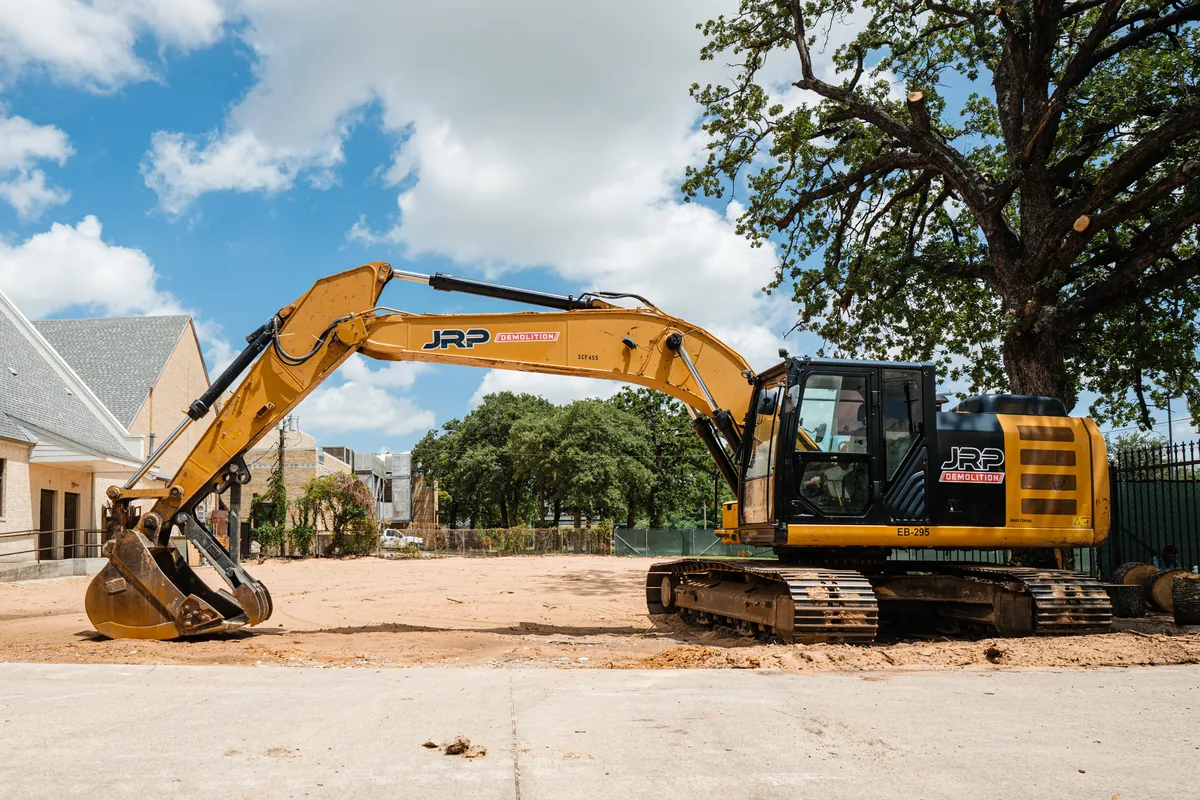
Demolition isn’t done when the walls come down. After the structure is removed, the crew loads all debris into roll-off containers for disposal. According to the EPA, up to 70% of building materials can be recycled through responsible sorting, and many demolition contractors (including JRP) separate concrete, metal, and clean wood from general debris to minimize landfill impact.
Once the debris is cleared, the site is graded and compacted to prepare it for whatever comes next, whether that’s new construction, landscaping, or sale. At the end of the project, you should have a clean, level lot with no remaining debris.
How Long Does Residential Demolition Take in Dallas?
Most residential demolition projects in Dallas take one to three weeks from the day the permit is issued to the final cleanup. The actual tear-down itself is the fastest part, often taking just one to three days for a standard single-family home. The bulk of the timeline goes to preparation and post-demolition work.
Here’s a typical timeline breakdown:
| Phase | Estimated Timeline |
|---|---|
| Permit processing | Same-day to 2 weeks (longer in historic districts) |
| Utility disconnection | 1 to 3 weeks |
| Asbestos testing/abatement | 3 to 10 days (if needed) |
| Demolition | 1 to 3 days |
| Debris removal and site grading | 2 to 5 days |
| Total project timeline | 1 to 3 weeks (typical) |
Several factors can extend the timeline. Properties in historic overlay districts face a mandatory 45-day delay before the permit is granted. Extensive asbestos contamination can add a week or more for abatement. And severe weather (which Dallas certainly gets its share of) can pause work temporarily.
The most common cause of delays is utility disconnection. We always recommend starting the disconnection process as early as possible because utility providers work on their own schedules.
Should You Demolish or Renovate?
Demolition makes sense when renovation costs exceed 50% of your home’s current market value, when the foundation or structural system is compromised beyond practical repair, or when hazardous materials are so extensive that remediation would cost nearly as much as starting over.
Here are five questions to help you decide:
- What’s the renovation estimate? Get detailed bids from both a renovation contractor and a demolition contractor. If the renovation bid approaches or exceeds half of your home’s appraised value, demolition and rebuilding is often the better investment.
- Is the foundation sound? A structural engineer can tell you whether your foundation can support a major renovation. If it can’t, you’re looking at demolition regardless.
- Are there hazardous materials? Widespread asbestos or lead paint can make renovation significantly more expensive and disruptive than tearing down and starting fresh.
- Does the floor plan work? If the layout doesn’t meet your needs and reconfiguring it would require removing load-bearing walls, a new build gives you total flexibility.
- What’s the neighborhood trending toward? In Dallas neighborhoods where property values are climbing and new construction is replacing older homes, demolishing and rebuilding often results in higher resale value than renovating.
Renovation makes more sense when the home has good bones, the systems (electrical, plumbing, HVAC) are serviceable, and the changes you need are mostly cosmetic or limited to one section of the house.
Consider Demolition When:
- ✓ Renovation costs exceed 50% of home value
- ✓ Foundation has major structural damage
- ✓ Widespread asbestos or lead paint
- ✓ You need a completely different floor plan
- ✓ Neighborhood is trending toward new builds
Consider Renovation When:
- ✓ The home has solid structural bones
- ✓ Electrical, plumbing, and HVAC are serviceable
- ✓ Changes are mostly cosmetic
- ✓ Work is limited to one section of the house
- ✓ The existing layout meets your needs
How to Choose a Residential Demolition Contractor in Dallas
Choosing the right contractor is the most important decision you’ll make in this process. The wrong choice can lead to safety hazards, permit violations, hidden fees, and a lot of stress. Here’s what to look for.
Verify licensing and insurance. In Texas, demolition contractors should carry general liability insurance and workers’ compensation coverage. Ask to see certificates of insurance before signing anything. A contractor who hesitates to provide proof of insurance is a contractor you should walk away from.
Get a written estimate. A professional contractor will visit your property, assess the scope of work, and provide a detailed written estimate before any work begins. The estimate should clearly spell out what’s included: demolition, debris removal, permit fees, site grading, and any exclusions. At JRP Demolition, we pride ourselves on complete transparency with our estimates. No hidden fees, no surprises.
Ask about their safety record. Demolition is inherently hazardous work. Ask how the contractor approaches safety planning, what training their crew receives, and whether they’ve had any OSHA citations or serious incidents. Safety isn’t just a checkbox for us at JRP Demolition. It’s our top value.
Check references and reviews. Look at Google reviews, ask for references from recent projects, and verify that the contractor has experience with projects similar to yours. A company with over 10 years of experience and a strong local reputation is a safer bet than the lowest bidder with no track record.
Ask who handles permits. A full-service contractor will manage the permit application, utility coordination, and any required inspections on your behalf. If a contractor expects you to handle permitting yourself, that’s a sign they may not be offering truly full-service demolition.
Understand the debris plan. Ask where the debris will go and whether any materials will be recycled. Responsible waste disposal is both an environmental consideration and a reflection of how a contractor operates overall.
Conclusion
Residential demolition in Dallas is a straightforward process when you have the right information and the right contractor. The key steps are understanding your costs ($6,000 to $25,000 for most homes), securing a City of Dallas demolition permit, testing for asbestos if your home was built before 1980, and working with a licensed, insured contractor who handles everything from permits to cleanup.
At JRP Demolition, we’re a family-owned and operated demolition company with over 10 years of experience serving homeowners across the DFW metroplex, including Dallas, Fort Worth, Plano, Arlington, and Irving. We handle residential demolition projects of every size, and we pride ourselves on making the process safe, efficient, and transparent.
Ready to Get Started?
Call us for a free on-site estimate. No obligation, no pressure.
Amaury Ponce
Amaury Ponce is the founder of JRP Demolition, a family-owned and operated demolition company serving the Dallas-Fort Worth metroplex. With over 10 years of hands-on experience in residential and commercial demolition, Amaury oversees every aspect of the business from project estimation to final site cleanup.
Frequently Asked Questions
How much does it cost to tear down a house in Dallas?
Most residential demolitions in Dallas cost between $6,000 and $25,000, depending on the size of the home, construction materials, and site conditions. The average cost falls between $4 and $15 per square foot. Additional expenses like permit fees, utility disconnections, and asbestos testing can add $1,000 to $5,000 or more to the total. The best way to get an accurate estimate is to schedule a free on-site assessment with a licensed demolition contractor.
Do I need a permit to demolish a house in Dallas, TX?
Yes. The City of Dallas requires a demolition permit for any structure over 120 square feet. The permit fee starts at $42 plus $0.021 per square foot. You’ll need to show proof of ownership, a site plan, confirmation that utilities have been disconnected, and (for homes built before 1980) an asbestos survey. Your demolition contractor should handle the permit application on your behalf.
How long does it take to demolish a house in Dallas?
The actual tear-down of a standard single-family home takes one to three days. However, the full project timeline, including permits, utility disconnection, hazardous material testing, demolition, and cleanup, typically runs one to three weeks. Properties in Dallas’s historic overlay districts may face an additional 45-day waiting period before the permit is issued.
Does residential demolition include debris removal?
With a reputable full-service contractor, yes. Debris removal, hauling, and basic site grading should all be included in your demolition estimate. Make sure your written estimate specifically lists debris removal as an included service. Some contractors quote a low price for the tear-down and then charge separately for hauling, so always ask upfront.
Can I demolish only part of my house?
Yes. Partial demolition and interior demolition are both common services. Partial demolition involves removing a section of the home (such as a garage, addition, or wing) while leaving the rest of the structure intact. Interior demolition strips the inside of the home down to the studs for a full renovation. Both require more precision than a full tear-down because the remaining structure must be protected throughout the process.